

Table of Contents
Introduction:
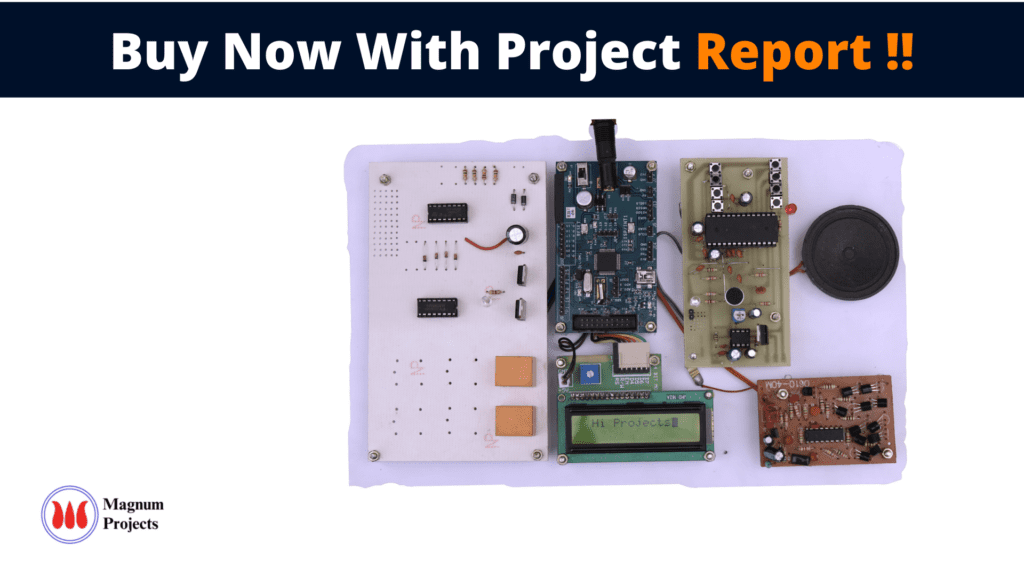
Now a day’s electronic devices become smaller and lower in power Requirements, and they are less expensive. In-car entertainment has come a long way since 1930 when Motorola introduced the first commercially successful car radio, the Model 5T71. Over the past 80-plus years, car audio has evolved from the basic AM radio receiver with a single speaker to complex electronic systems reproducing music and other entertainment from both over-the-air signals and recorded formats. Many systems today can play music from a staggering array of audio sources: radio, CD, portable music players like the iPod, USB flash drives, SD cards, Bluetooth audio, and hard disk drives. The overwhelming number of audio choices can make the average consumer’s head spin. Nowadays vehicles will play songs anytime and anywhere that shouldn’t happen and those vehicles should play music (Devotional songs) when they are near to temple and they should shut at home. This project will deal with these features.
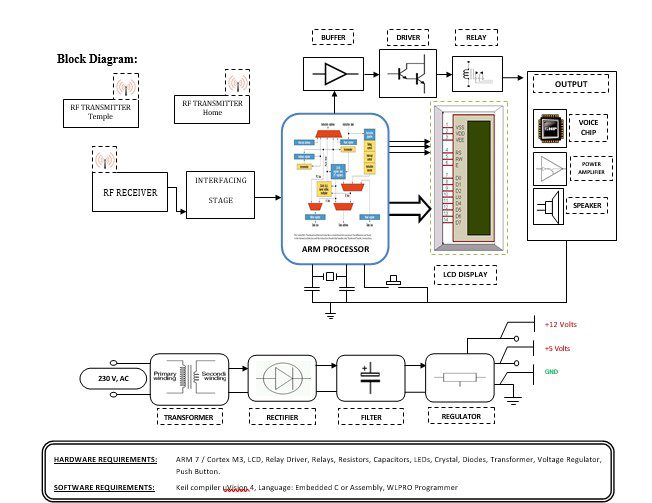
Block diagram explanation
Power supply unit
This section needs two voltages viz., +12 V & +5 V, as working voltages. Hence specially designed power supply is constructed to get regulated power supplies.
RF transmitter
RF transmitters are electronic devices that create continuously varying electric currents, encode sine waves, and broadcast radio waves. RF transmitters use oscillators to create sine waves, the simplest and smoothest form of continuously varying waves, which contain information such as audio and video. Modulators encode these sign wives and antennas broadcast them as radio signals. There are several ways to encode or modulate this information, including amplitude modulation (AM) and frequency modulation (FM). Radio techniques limit localized interference and noise.
RF receiver
RF receivers are electronic devices that separate radio signals from one another and convert specific signals into audio, video, or data formats. RF receivers use an antenna to receive transmitted radio signals and a tuner to separate a specific signal from all of the other signals that the antenna receives. Detectors or demodulators then extract information that was encoded before transmission. There are several ways to decode or modulate this information, including amplitude modulation (AM) and frequency modulation (FM). Radio techniques limit localized interference and noise.
ARM processor
ARM is a computer processor-based RISC architecture. A RISC-based computer design approach means ARM processors require significantly fewer transistors than typical processors in average computers. This approach reduces costs, heat, and power use. The low power consumption of ARM processors has made them very popular:
The ARM architecture (32-bit) is the most widely used in mobile devices, and the most popular 32-bit one in embedded systems.
Buffers
Buffers do not affect the logical state of a digital signal (i.e. a logic 1 input results in a logic 1 output whereas logic 0 input results in a logic 0 output). Buffers are normally used to provide extra current drive at the output but can also be used to regularize the logic present at an interface
Drivers
This section is used to drive the relay where the output is the complement of input which is applied to the drive but the current will be amplified
Relays
It is an electromagnetic device that is used to drive the load connected across the relay and the o/p of the relay can be connected to the controller or load for further processing.
Voice recorder:
The aPR33A series are powerful audio processors along with high-performance audio analog-to-digital converters (ADCs) and digital-to-analog converters (DACs). The aPR33A series is a fully integrated solution offering high performance and unparalleled integration with analog input, digital processing, and analog output functionality. High-quality audio/voice systems with lower bill-of-material costs can be implemented with the aPR33A series because of its integrated analog data converters and a full suite of quality-enhancing features such as sample-rate converters.
In this messages must be recorded or played back sequentially, specially designed for simple key triggers, the user can record and playback the message. Meanwhile, this mode provides a power-management system.
Methodology:
This Location driven car music player (plays devotional songs near temples, shuts at home) module consists of RF transmitters, an RF receiver, a Driver, an ARM controller unit, and the Voicebank. Two RF transmitters are placed in the Home and Temple. RF receiver will be there in CAR. As the transmitted signal is received from the RF transmitter and that signal will be given to the ARM controller via the interfacing stage. The ARM controller will analyze the signal and play devotional songs near temples, and shut at home based on the received frequency from the RF receiver.
Advantages:
- All the components required are easily available.
- It is accurate [Errors are nullified] & precise as it is Digital.
- It is much more Economical compared to other analog systems.
- Automatically controlled & Easy to use.
- Very low power consumption
- Excellent performance in environments with low SNR
- Can be used globally
Disadvantages:
- One-time investment cost.
- It has to be planted throughout the city.
Applications:
- This project can be implemented in homes, Schools, Colleges, Companies, etc…
- Can be implemented in trains and buses.
- Useful for the visually impaired as an information guide for transportation services using suitable modifications.
- Can also be used as a location identifier using suitable modifications.